What it is
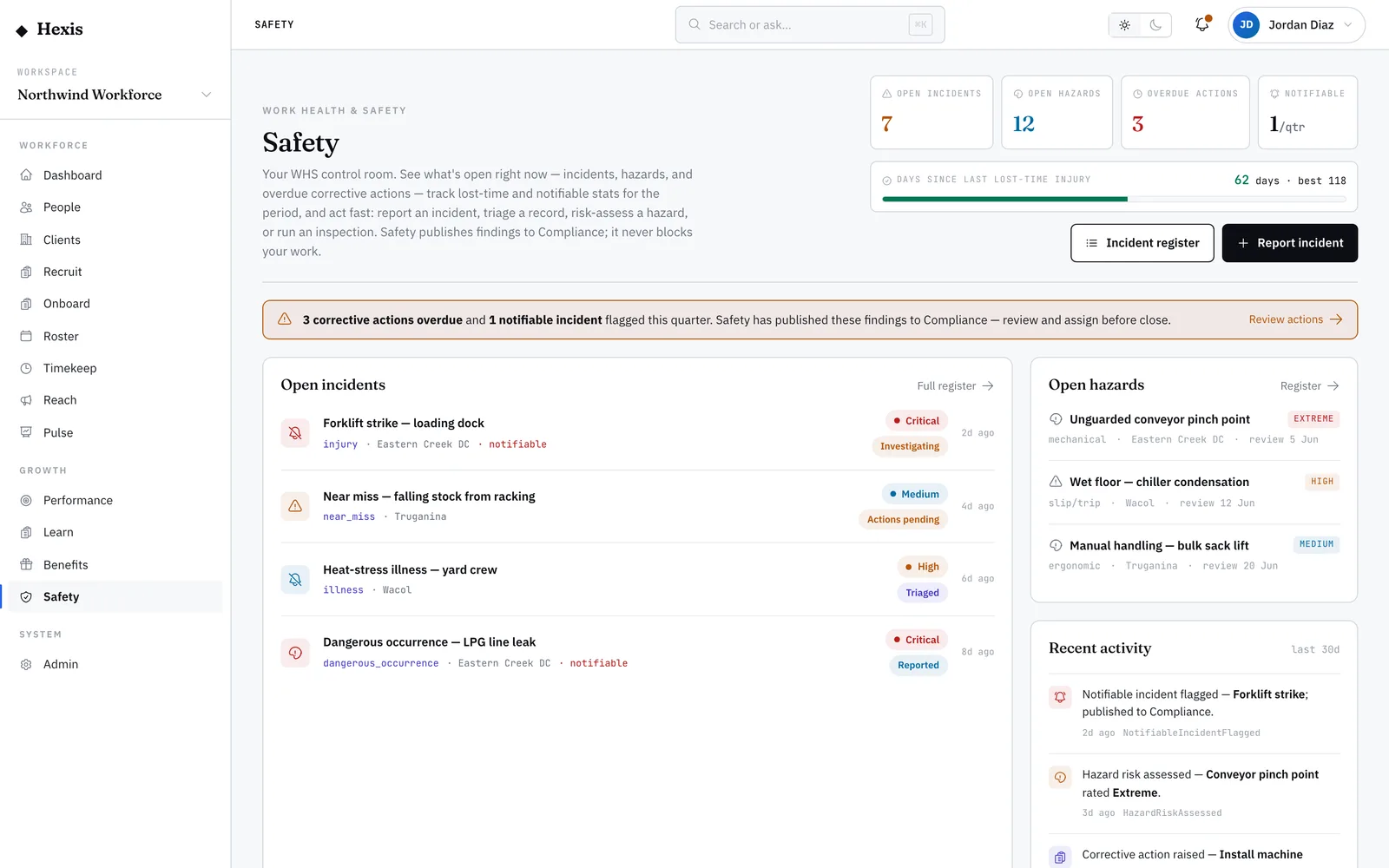
A hazard is something on site with the potential to cause harm — a trip point, a chemical store, a piece of plant. Reporting one puts it in the register; the hazard record is where you assess how bad it is, decide what to do about it, and set when to look again. You rate it on a likelihood-by-consequence matrix to get a risk rating, add control measures, and watch the residual risk drop as you do.
Hazards are the leading edge of safety — they are the harm you stop before it happens. Working a hazard through identified, assessed, controlled and under review means risk is managed deliberately, not left to chance, and the register answers the question every audit asks: what risks do you carry, how bad are they right now, and which are due for review.
When to use it
- Someone spots a hazard that needs assessing and controlling
- You want to know which hazards are high or extreme risk right now
- A control has been put in place and you want to record the reduced residual risk
- A hazard is due for its scheduled review
How it works
Step by step.
- 1
Log the hazard
Open a new hazard from the register, give it a category and a site, and describe what and where it is.
- 2
Assess the risk
On the likelihood-by-consequence matrix, pick the cell that matches. The risk rating — low through extreme — is set for you.
- 3
Add control measures
List what reduces the risk, working down the hierarchy of control: eliminate first, then substitute, isolate, engineer, administer, and finally protective equipment.
- 4
Check the residual risk
As controls go on, re-rate to show the residual risk after controls. The record shows initial against residual side by side.
- 5
Set a review date
Decide when this hazard is looked at again. The register flags it when the review falls due.
- 6
Close when retired
If the hazard is eliminated, close the record. It stays on file as evidence the risk was managed.
Worked example
Follow it through.
The scenario
A pooling-water hazard near the loading dock at Harbour Point Terminal is reported during a Coastline Logistics shift.
- 1 Log a hazard, category "Slips, trips and falls", site Harbour Point Terminal, location "Dock 2 apron".
- 2 Assess it on the matrix: likelihood "Likely", consequence "Moderate" — risk rating High.
- 3 Add controls: "Re-grade drainage" (engineering) and "Hi-vis cones plus anti-slip mat" (administrative) while the fix is scheduled.
- 4 Re-rate residual risk to Medium with the interim controls in place.
- 5 Set a review date of Mon 23 Jun to confirm the drainage works held.
- 6 Assign the drainage fix as a corrective action to Jack Mason.
The result
The dock hazard sits at residual risk Medium with two controls recorded, a review date set, and a drainage fix tracked as an action.
Tips & notes
Good to know.
- Always reach for the top of the hierarchy first — eliminating a hazard beats relying on people remembering to wear protective gear.
- The matrix colour tells the story fast; filter the register to High and Extreme to see where to spend your attention.
- Record interim controls even when a permanent fix is pending — they are what keeps people safe in the meantime.
- A control that needs work to put in place can be raised as a corrective action, so it gets an owner and a due date.
When you’re done
The hazard is assessed, controlled and scheduled for review, with the residual risk and its evidence on the record.